 AUSTRALIA · CONVEYOR BELTING
Belt construction
Aramid (DPP) Conveyor Belting
Lightweight, high-strength aramid reinforcement for long-distance, high-tension and weight-sensitive conveyor systems.
Product overview
Built around the duty.
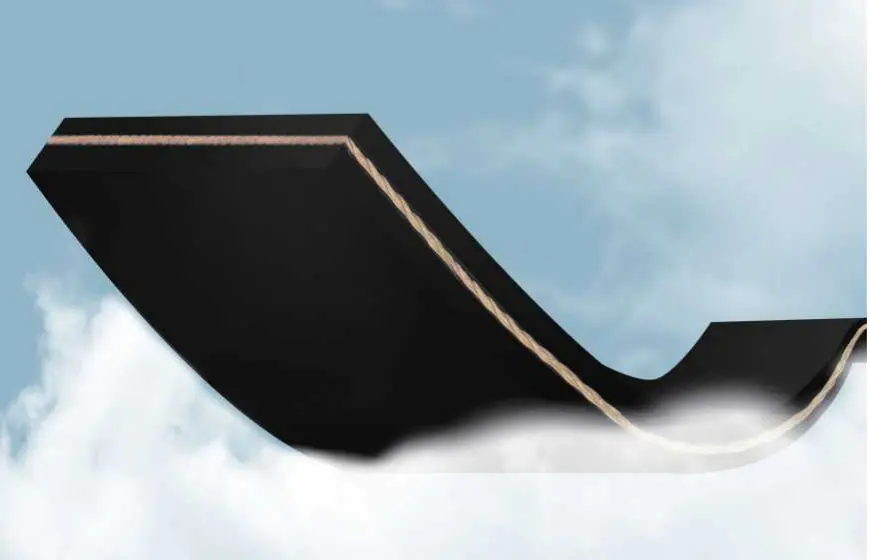
Aramid DPP belting uses a high-strength straight-warp aramid tensile member to carry high longitudinal load with substantially less belt mass than a comparable steel-cord construction. Low elongation, fatigue resistance and transverse protection make it a strong option where conveyor power, take-up demand, impact exposure or structural load are important design constraints.
Construction & selection
What defines this product.
- High tensile strength-to-weight ratio
- Published 0.5% elongation at 10% load across the listed DPP range
- Aramid toughness supports cut, chip and puncture resistance
- Fatigue-resistant, flexible single-ply carcass
- Good chemical and corrosion resistance of the aramid reinforcement
Typical applications
Where it fits.
- 01Long overland and high-lift conveyors
- 02Weight- and power-sensitive systems
- 03High-impact or puncture-exposed duties
- 04Aramid pipe-conveyor applications
How the construction works
High tensile capacity with less moving mass.
The aramid tensile member changes more than the belt weight. It affects the conveyor power model, take-up travel, pulley selection, transition geometry and splice design, so the complete system must be checked as one package.
Lightweight tensile member
Aramid fibre concentrates longitudinal strength in a single, flexible carcass with low published elongation.
Structural protection
Transverse reinforcement and cover thickness are selected to protect the high-value carcass from impact, puncture and rip damage.
Energy package
Lower belt mass can reduce the moving load; an LRR pulley-side compound can be added where the conveyor model supports it.
Published product range
DPP construction reference.
These are the sample constructions published in the supplied Aramid Conveyor Belt sheet. Cover thickness and belt mass change with the final duty.
| Designation | Tensile strength | Elongation at 10% load | Sample covers | Sample mass |
|---|---|---|---|---|
| DPP800 | 800 N/mm | 0.5% | 6 + 3 mm | 15.6 kg/m² |
| DPP1000 | 1,000 N/mm | 0.5% | 6 + 3 mm | 15.8 kg/m² |
| DPP1250 | 1,250 N/mm | 0.5% | 6 + 3 mm | 16.1 kg/m² |
| DPP1600 | 1,600 N/mm | 0.5% | 6 + 4 mm | 17.4 kg/m² |
| DPP1800 | 1,800 N/mm | 0.5% | 6 + 4 mm | 17.7 kg/m² |
| DPP2000 | 2,000 N/mm | 0.5% | 8 + 4 mm | 20.3 kg/m² |
| DPP2250 | 2,250 N/mm | 0.5% | 8 + 4 mm | 20.8 kg/m² |
| DPP2500 | 2,500 N/mm | 0.5% | 8 + 5 mm | 22.3 kg/m² |
| DPP3150 | 3,150 N/mm | 0.5% | 8 + 5 mm | 23.0 kg/m² |
| DPP3500 | 3,500 N/mm | 0.5% | 8 + 6 mm | 24.9 kg/m² |
| DPP4000 | 4,000 N/mm | 0.5% | 8 + 6 mm | 25.6 kg/m² |
Published reference values are not a substitute for an approved belt data sheet. Width, edge construction, cover grade, splice design and minimum pulley diameters must be confirmed for each order.
Published comparison
A lighter route to high strength.
The supplied product sheet compares aramid with a steel-cord belt of the same tensile strength and also describes the additional effect of an LRR bottom cover.
Lower belt mass
Published comparison against a steel-cord belt of the same tensile strength.
Lower energy consumption
Published comparison attributed to the lower moving belt mass.
With LRR rubber
Published potential when an LRR pulley-side cover is combined with the aramid carcass.
These are brochure comparison claims, not guaranteed project outcomes. Conveyor geometry, loading, speed, idlers, temperature, cover thickness and operating conditions must be modelled before any energy-saving commitment is made.
Specification note
Aramid construction is engineered against the complete conveyor duty. Confirm pulley diameters, transition geometry, take-up, splice design, cover system and local splicing capability before selection.
Need help specifying a belt?